Inventing remote work: a matter of technical and cultural change (1960s-1970s)

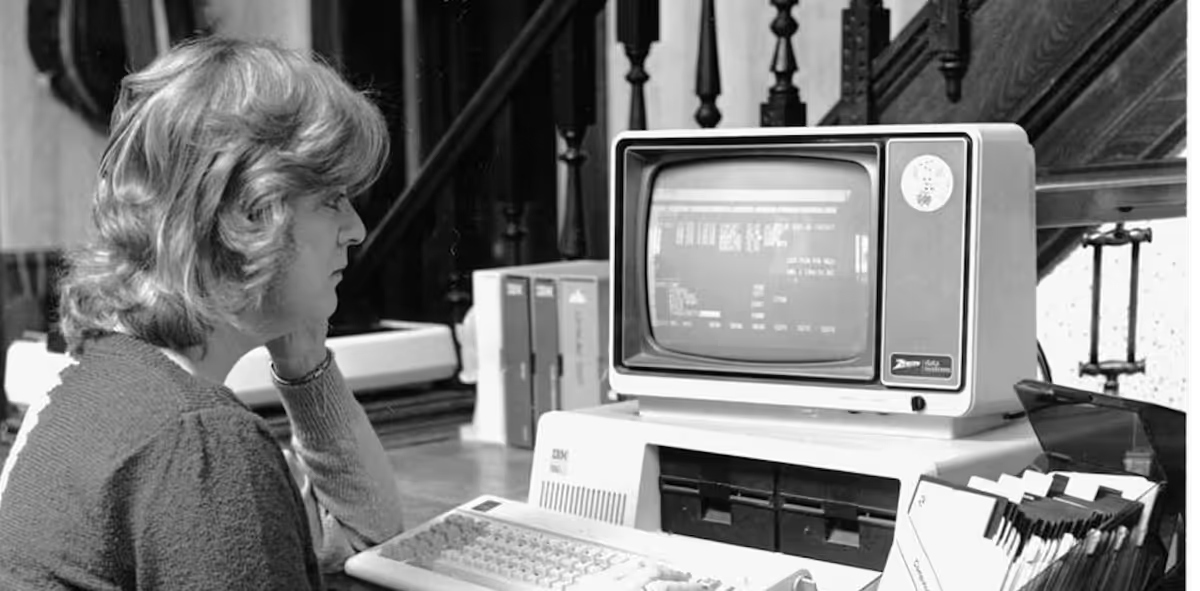
I turned 40 in 2024.
If somebody had told me, when I was in high-school in the early 2000s, that my future was to work on a laptop at home, I wouldn't have believed it. I guess nobody would have believed that a global pandemic and national "stay at home" policies would occur in their lifetime either. In fact, I realized that remote work does not have a lot of representations. It is not advertised visually on posters and magazines, it does not really fit into popular representations of a successful career, despite being around since the 1970s.
Today, the impact of remote work on millions of people's lives and careers is massive. About one billion people (one third of the workforce globally) work either in a hybrid model or in a full remote set up, juggling all day between Zoom, Slack, Trello, Jira, Confluence, Microsoft Office, calendars and more tools that developed for asynchronous work. We tend to think of remote work as a modern, novel idea, but it is, in fact, not new at all. It existed even before the invention of the web!
The invention of "telecommuting"
There are of course many instances of home-based professions (farmers, doctors, artists, writers, some manufacturing work, etc.) in the history of humanity, but the idea of working from home as an employee of a corporation while being connected to a central office was really a new concept that emerged in the 1960s, following the diffusion of phone lines.
It was simply not technically possible to consider it before. From mechatronics workshops before WW2, to the rise of mainframe computer rooms in the 1950s, information technology jobs had always required a physical presence of all operators on site. All networks were internal only, and there were no system nor infrastructure available to allow for information transfer toward external terminals in a scalable way.
For more context on this, you can take a look at our article about the Tim Berners-Lee and the invention of the World Wide Web.
In 1969, Allan Kiron, staff scientist at the US Patent Office (USA), wrote in the Washington Post that the combination of computers and communication tools could potentially change the way of work and life forever. He coined the term “dominetics” to describe the link between domicile, connections, and electronics. While Kiron’s terminology didn’t last, his concept did, and lead others to elaborate on the idea.
The invention of the term "telecommuting" is attributed to NASA engineer Jack Nilles, who published in 1976 a book called "The Telecommunications-transportation tradeoff : options for tomorrow", in which Nilles stated that:
Either the jobs of the employees must be redesigned so that they can still be self-contained at each individual location, or sufficiently sophisticated telecommunications and the information-storage system must be developed to allow the information transfer to occur as effectively as if the employees were centrally collocated. - Jack Nilles
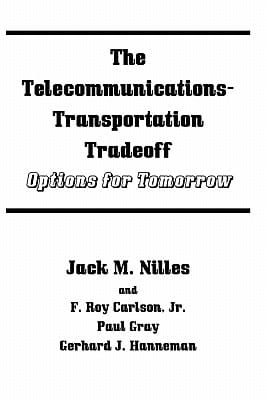
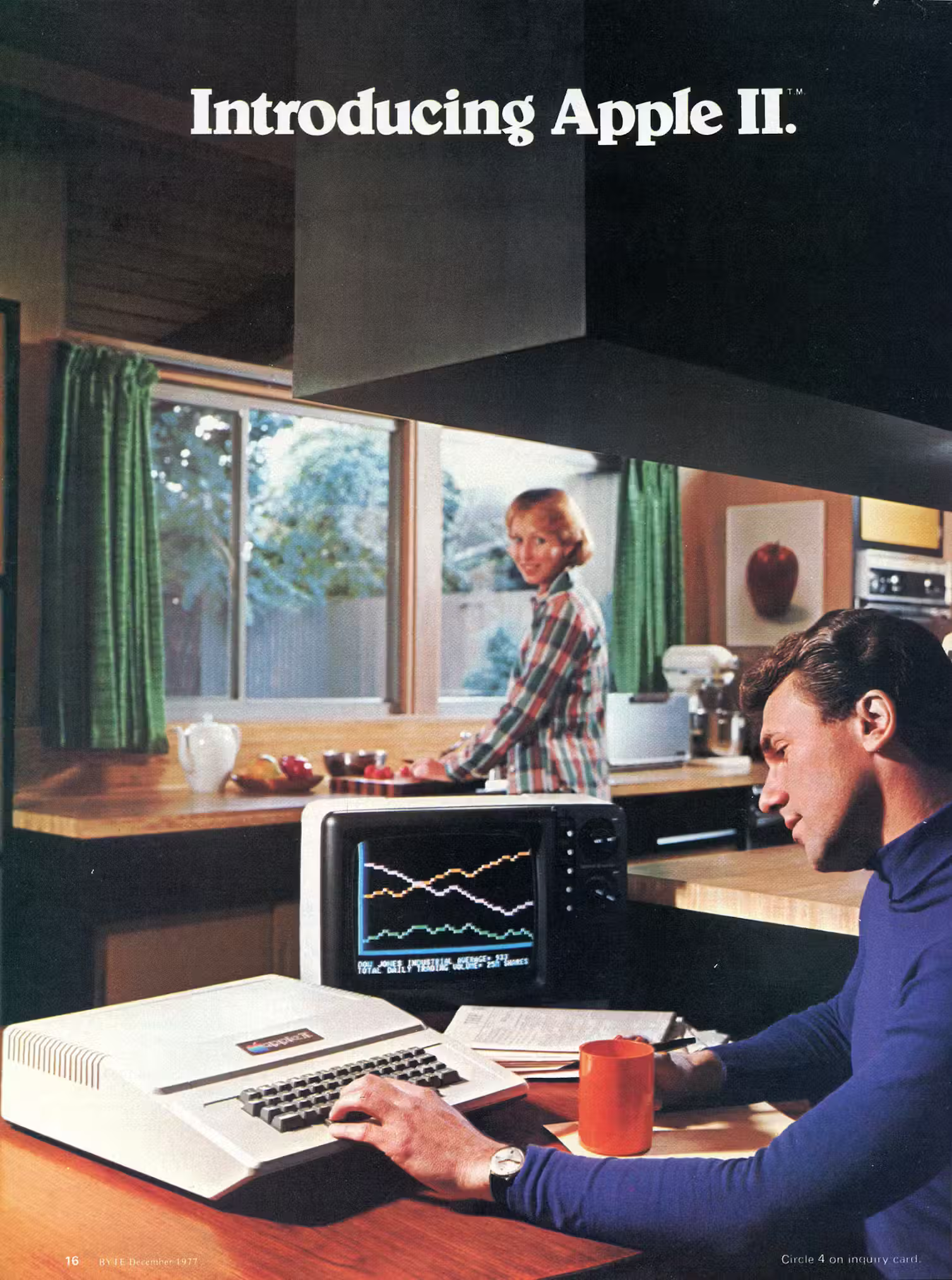
The book concluded that technology would soon make it more economical for organizations to decentralize using telecommuting. Only telefax and landline phones were available at the time, which was a major obstacle to the development of "telecommuting" at scale. The personal computer was not a common good among the population, and there were no Internets available to the public yet. That started to shift in the 1970s, with the launch of the first personal computers, like the Apple II for instance, in 1977, for which the ad showcased a man working from home on his computer.
The IBM experiments
In 1979, IBM, one of the world's largest computer and technology companies, launched a work-from-home program called "Telecommuting," making it the first major corporation to offer such an arrangement to its employees. The program allowed certain employees to work from home or other remote locations for up to three days a week.
Only four years after IBM moved those five employees to remote work, about 2,000 of its staff were telecommuting. That made IBM one of the earliest major companies to move large numbers of employees to remote work. By 1987, about 1.5 million Americans were working remotely. IBM continued to embrace the idea, growing its remote workforce to 40 percent of its 386,000 employees in 2009.
He wrote this piece in a context of energy crisis and oil shock, but very accurately predicted what remote work could be and the impacts it could have (especially, on oil consumption, as well as on the physical and mental wellbeing of employees). This discrete, yet amazing article was rediscovered during the pandemic years by Mitch Daniels, who published an article about how Schiff predicted the future of remote work.
Cultural obstacles
Even if the technical conditions for remote work started to improve from then, and continued to do so in the next decades, the progress of remote work remained fairly slow even in the IT sector. Some public services in many countries conducted remote work experiments, including even the French Post Office. Those were often carried by motivated managers, but rarely convinced entire organizations. That changed during the pandemic in 2020 provoked a global shock and forced remote work on most knowledge-production jobs.
We can still observe some mistrust today, even if the amount of remote workers in all fields has dramatically increased since the 1970s. Yet companies keep going back and forth on their remote policies, just like IBM in 2017, but also Ubisoft and Amazon in 2024. Companies recalled all employees to their main office five days a week, generating massive protests among their staff.
Women, programming and remote work
As often, the history of remote work is dominated by big corporation initiatives and books published by men from well-established institutions, with a north-american perspective. Yet I discovered that two women, rarely mentioned in any articles about remote work history, were pioneers of this type of work as early as 1962, in the UK. Those stories emphasize how political remote work actually is, and how it impacts people differently depending on gender.
Dame Shirley
Stephanie Shirley, also called Dame Shirley, founded at only 29 years old (and from her own home), a company called Freelance Programmers. That was in 1962.
Freelance Programmers was a company of women and for women, focused on creating an environment where women could manage their home and professional lives. To do that, she says, the business had to be “family friendly in the extreme”, with flexible hours and homeworking encouraged. Many of her female employees had left work after getting married or having their first child but they all had good degrees.- Louise Tickel, for the Guardian
Her revolutionary take on providing a way for qualified women to keep working after having kids allowed for seventy of her staff members to become millionaires in the decades to come. She herself became one of the most successful businesswoman of her time, and a pioneer also in the field of commercial software that were - as she states in the video - "given for free" at the time, and said to "never become a profitable business".
Hilary Cropper
Hilary Cropper took the direction of Dame Shirley's company in 1985, and perpetuated her work to empower women employees with flexible, remote options, as well as generous stock options (at the time, women accessing capital was even less expected than it is nowadays). At International Computers Limited (ICL), Hilary sat up part-time, home-based employment for employees who wanted it, and continued during all her career to empower women employees in the field of software and programming.
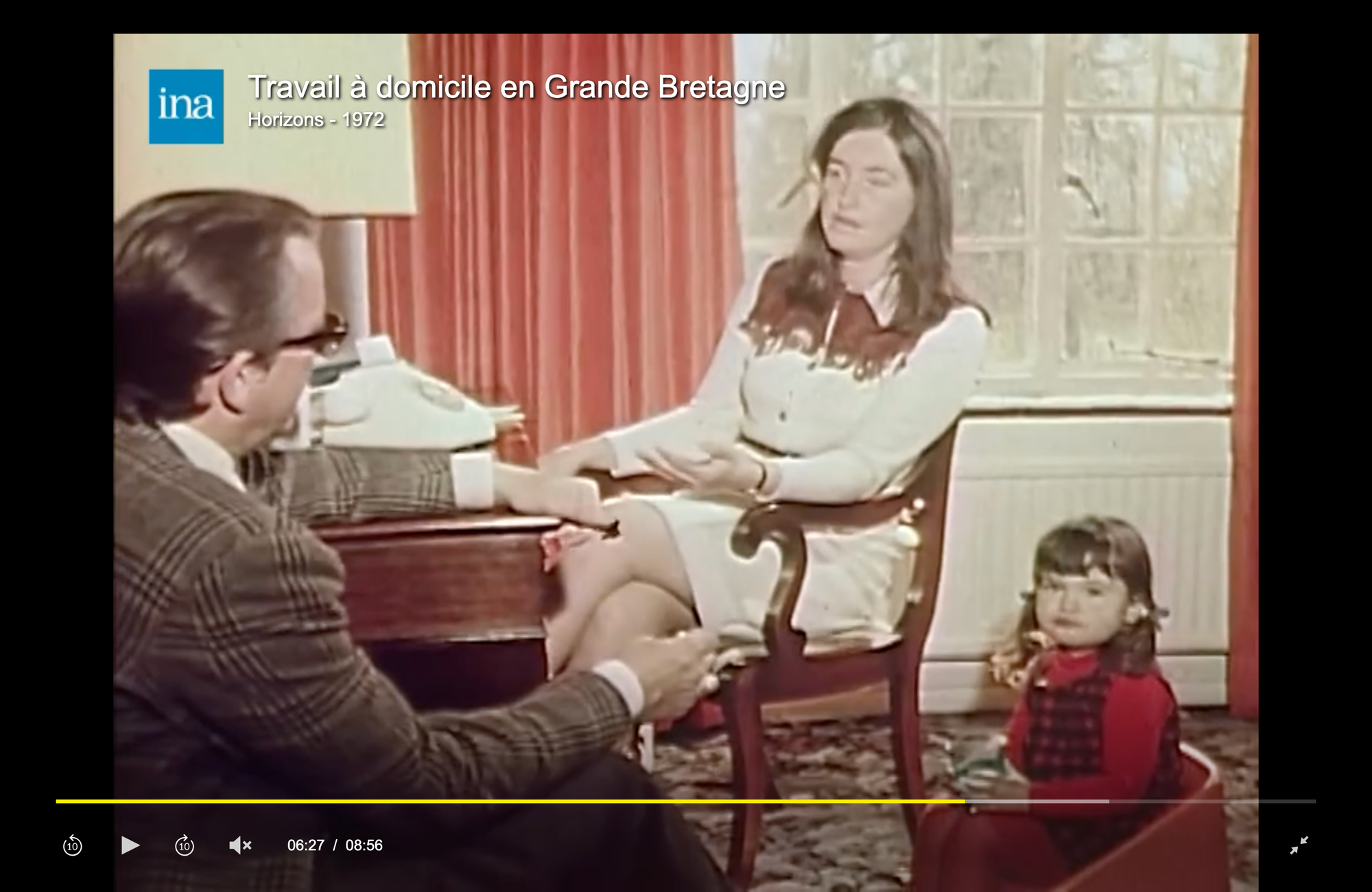
She was featured in a documentary about remote work at a time when women were defined as "housewives" and "homemakers" with little to no considerations for their intellectual, business and technical aptitudes. The documentary (in French) can be found here. I highly recommend watching it, it is very telling of what early remote work looked like using a landline connection to the mainframe room in the main office. It also shows how women programming remotely were taking care of young kids at home while working with no support.
Remote work doesn't fix everything...
Implementing remote work for women who also had to care for children with no support at all was (and still is) very difficult. As many realized during the pandemic of 2020, having to deal with young kids while having to work in the same space is a very stressful situation that leads to exhaustion and mental overload.
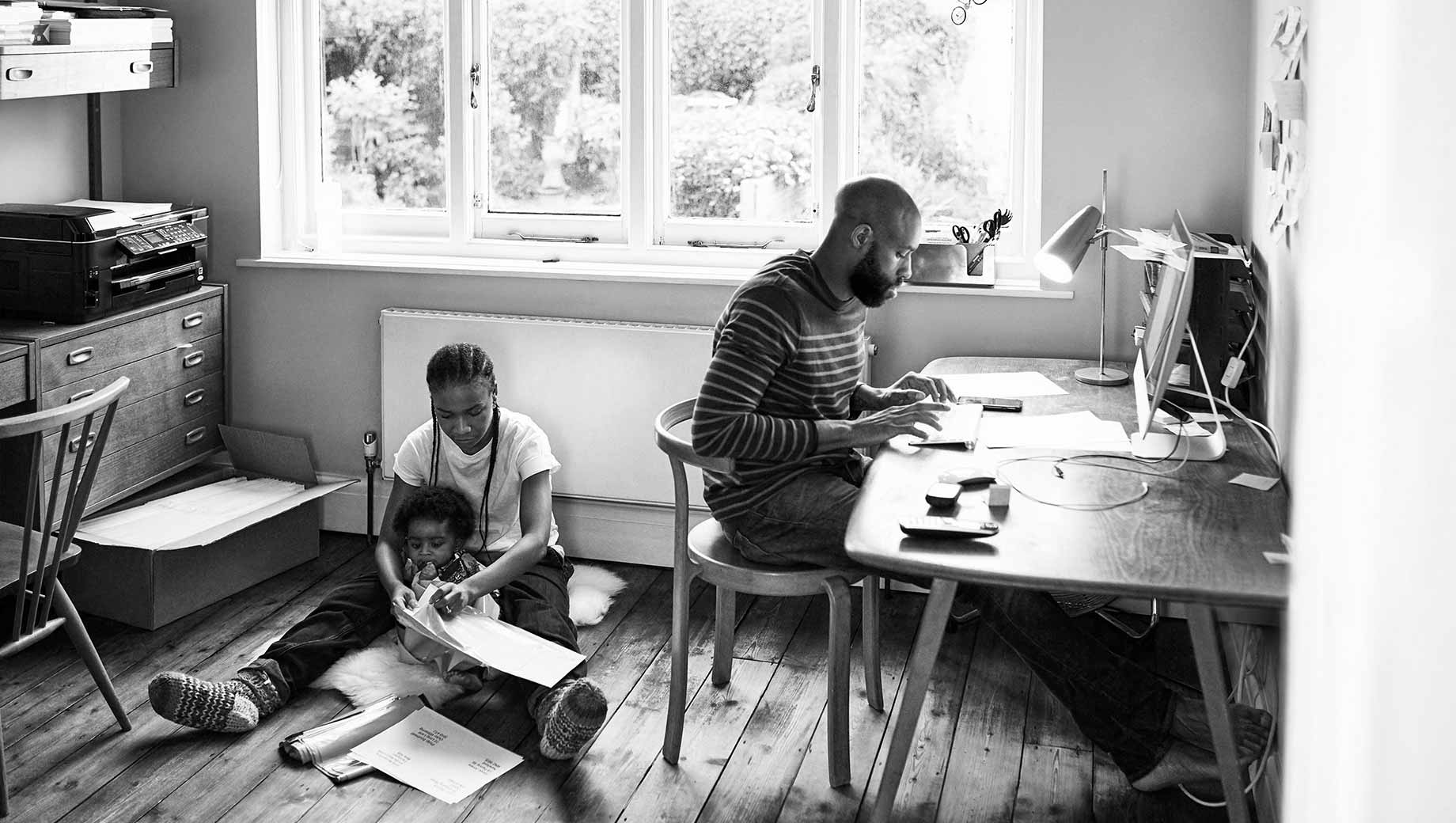
Already in 1988, social scientist and author Kathleen Christensen published a book called "Women and home-based work: the unspoken contract", where she revealed the ambivalent results of her study conducted on female remote workers on the realities of what we call today the mental load of domestic tasks. As the LA Times review stated in 1987:
Despite advances for women in other arenas, at home little has changed. As these intimate and compelling narratives reveal, women who work at home still are victimized by the traditional husbands needlessly and often unconsciously maintain.
In itself, the possibility to do one's work from home does not prevent the suffering of a low-paying job, repetitive tasks, mean managers and sadly does not help much with societal inequalities reflected in the home for many people, if the partner does not contribute to house chores or in single-parent households.
... but it is a game changer
The impact of remote or hybrid work on productivity and well-being has been extensively studied, especially since 2020. Some limitations persist, but overall, the possibility to conduct now full careers in remote/hybrid work has dramatically improved the financial, physical and mental wellbeing of many, and is empowering a lot of women as well to live a more balanced life.
In 2025, a lot of studies show that despite remaining inequalities between genders when working remotely, positive effects are tremendous:
- having more time to be with their family,
- having more time to care for their physical and mental health,
- having a life that is built around personal life and not the other way around,
- having great possibilities for career progression in a more sustainable way.
A significant part of people currently working remote/hybrid say they would leave their job if forced to return to the office. Remote has now become an essential part of how companies operate.